Want a Quick Summary?
Get ChatGPT to summarize this article for you in seconds.
For the past two years, digital marketers, brand strategists, and analytics teams have faced the same frustrating conundrum.
A client or stakeholder walks into a meeting and asks a simple question: “How much traffic are we actually getting from AI platforms like ChatGPT, Claude, and Gemini?” You would open Google Analytics 4 (GA4), click into your Referral report, sift through a messy heap of random backlinks, directory listings, and scraper bots, and give a helpless shrug. The honest answer was always: “It's in there somewhere, but we can't isolate it without messy custom regex filters.”
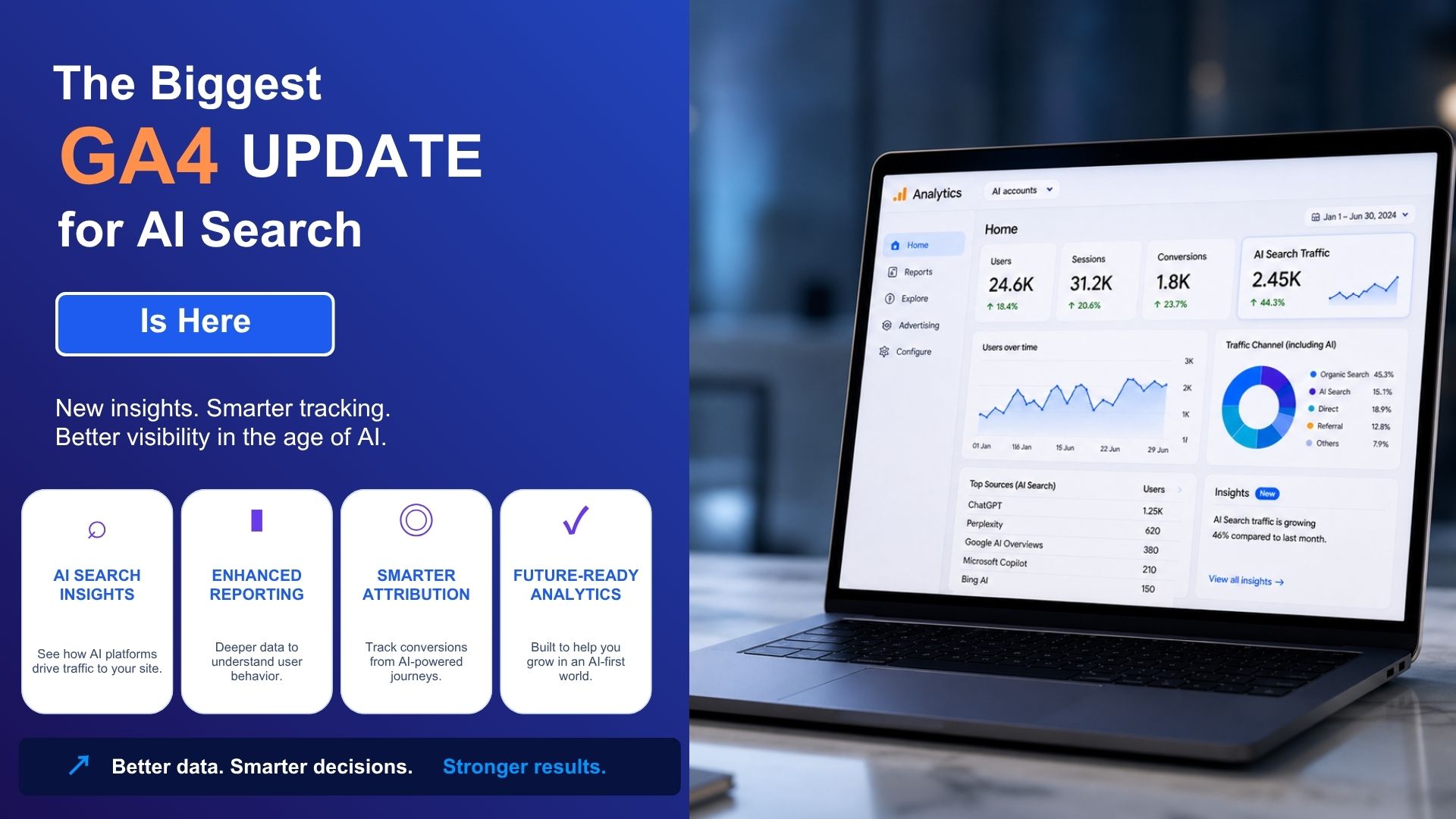
That era ended on May 13, 2026.
This is the date when Google rolled out the biggest measurement upgrade for generative engine optimization, and it's none other than a native AI Assistant channel within GA4's Default Channel Group. SEO Dubai has changed, and for those who want to understand how modern users discover your brand in an era dominated by AI Overviews and conversational search, this update is a major milestone. To further clear things up, here is a comprehensive breakdown of what changed, why it matters, the critical limitations you must know, and how you can turn these new insights into a competitive growth engine.
Primarily, the newest GA4 update creates a dedicated reporting channel that identifies visits from AI-powered platforms instead of grouping them with general referrals.
Before the release of this update, tracking artificial intelligence traffic required setting up custom channel definitions or complex Looker Studio dashboards. However, now, Google has standardized AI traffic measurement directly in the platform core. When GA4 detects a session originating from a recognized generative assistant, it automatically executes three simultaneous actions:
This automatic classification works much like when Google added the Cross-Network channel to separate Performance Max and Smart Shopping campaign data. Here, you don't need to add any code or change your tracking tags because the new traffic category will automatically appear in your Traffic Acquisition. User Acquisition, and Exploration reports.
The introduction of a native default channel is Google's explicit acknowledgement that AI-driven discovery is no longer a niche experiment; it's primarily a pillar of modern web traffic.
Historically, SEO focused almost exclusively on ranking blue links on Google's conventional search engine result pages. However, today, user journeys are fragmented across AI Overviews, LLM chat interfaces, voice prompts, and social engines.
Having a dedicated AI Assistant channel allows an SEO company in Dubai to:
When you are working with a top SEO Agency in Dubai, having a clean channel attribution makes it dramatically easier to justify budget allocation towards AI-focused content optimization and digital PR.
Here’s what becomes easier to measure:
| Feature | Before Update | After Update |
| AI traffic visibility | Mixed with referrals | Dedicated AI channel |
| Attribution | Limited | Much more accurate |
| Performance analysis | Difficult | Simple reporting |
| Campaign optimization | Guesswork | Data-driven decisions |
While this update is a monumental step forward, it's wrong to treat it as a complete picture of your AI impact. Rather, to interpret your analytics accurately, you need to keep these crucial nuances in mind:
The AI-Assistant channel can only categorize traffic when a clean HTTP referrer header is passed by the browser or app, but hundreds of AI-originated visits without referrer headers quietly land in the Direct channel bucket. This happens when users copy links from chat responses into new tabs or click out from native mobile apps.
When an AI assistant answers a user's question by summarizing your content directly inside the chat interface without triggering a link click, no web session occurs, and GA4 hence cannot track content consumption that happens entirely off-site inside an LLM interface.
In addition, GA4 does not retroactively classify historical data, so May 13, 2026, serves as your official baseline data. Hence, all AI-driven referrals before this date remain categorized under generic referral or Direct channels.
Collecting more data only works when businesses know how to use it. The dedicated AI traffic channel can help marketing teams to answer important questions, such as:
These insights can allow companies to invest in strategies that actually drive business growth.
Traditional SEO no longer paints the entire picture, which is why businesses now need content that performs well in both Google Search and AI-generated answers.
This means that creating pages that answer questions clearly, including helpful context, and demonstrating expertise. Well-structured articles with logical headings, concise explanations, trustworthy references, and practical examples are more likely to be cited by AI systems, and that makes content quality even more important than keyword repetition.
This is where a professional SEO agency in Dubai can help to combine ranking data with AI traffic reports to understand which optimization strategies generate visibility across both search environments.
Once AI traffic starts appearing inside GA4, marketers should monitor several important metrics, including:
When you monitor these metrics, it can help you create a much clearer understanding of AI search performance, which is a win-win in terms of engagement and visibility.
When it comes to AI search, tracking is only half the equation because businesses also need websites that AI systems can trust and recommend. To further clarify things, here are some pragmatic ways to help businesses prepare their websites for AI search:
Many businesses also refresh their website using professional services for web design in Dubai to improve user experience, help visitors stay longer, and convert more effectively after arriving through AI search.
The excitement around AI search has also created confusion for many people, and to help you dodge this confusion, here are some common mistakes that you can avoid:
A professional SEO company in Dubai can help you to move beyond these errors by combining traditional SEO, AI optimization, and analytics into one holistic strategy.
The latest GA4 update is a telltale sign of the fact that Google acknowledges how AI search is becoming a permanent part of digital marketing. Over the next few years, marketers should expect deeper AI reporting, better attribution models, improved conversion tracking, and stronger integration with search behavior across multiple AI platforms. This is why businesses need to learn how to interpret these insights for a successful competitive advantage.
Looking for an agency that can help you walk hand-in-hand with the latest Google updates? Reach out to the team at Pentagon today!
Which AI platforms can send traffic to GA4?
Many platforms can send traffic to GA4, including ChatGPT, Google Gemini, Microsoft Copilot, Claude, Perplexity, and other AI-powered search assistants.
Does AI traffic replace organic search traffic?
No, AI traffic is here to complement traditional organic search, and it provides another channel through which users can discover websites.
Can GA4 show AI conversions?
Yes, businesses can measure conversions from AI visitors, just as they do for organic, paid, and referral traffic.
Should businesses change their SEO strategy?
Rather than replacing SEO, businesses should expand their strategy to include content optimized for AI-generated answers.
Can I improve lead generation?
Yes, it can because businesses can now identify which AI platforms send visitors that convert into leads or customers.
Will historical referral data before May 2026 be updated automatically?
No, GA4 does not reclassify historical data. Traffic received before the update will remain in its original channel classifications (such as Referral or Direct). May 13, 2026, acts as the starting baseline.



Please, share your thoughts, and let's chat over a cup of tea.